
One Fly on Your
Production Line
Can Cost Everything.
FlyTrap is India’s first organic, food-grade fly trap — zero chemicals, zero residue, zero production downtime. Built for FSSAI compliance and export-safe operations.
Flies Are a Regulatory Crisis
in Food Processing
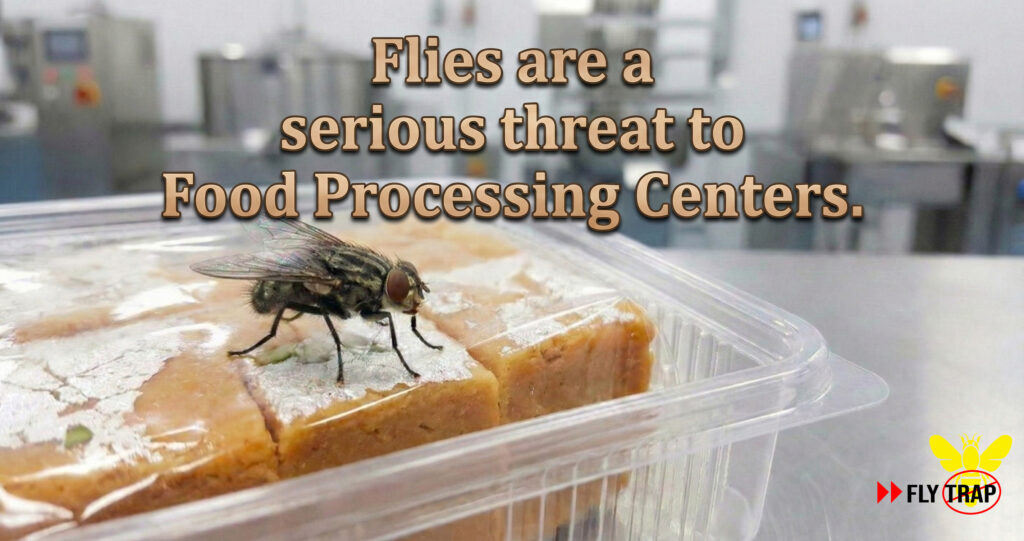
In India’s tropical climate, fly populations don’t grow — they explode. For a food processing unit, a single housefly is a biological hazard that can halt operations, cancel your FSSAI licence, and destroy export deals.
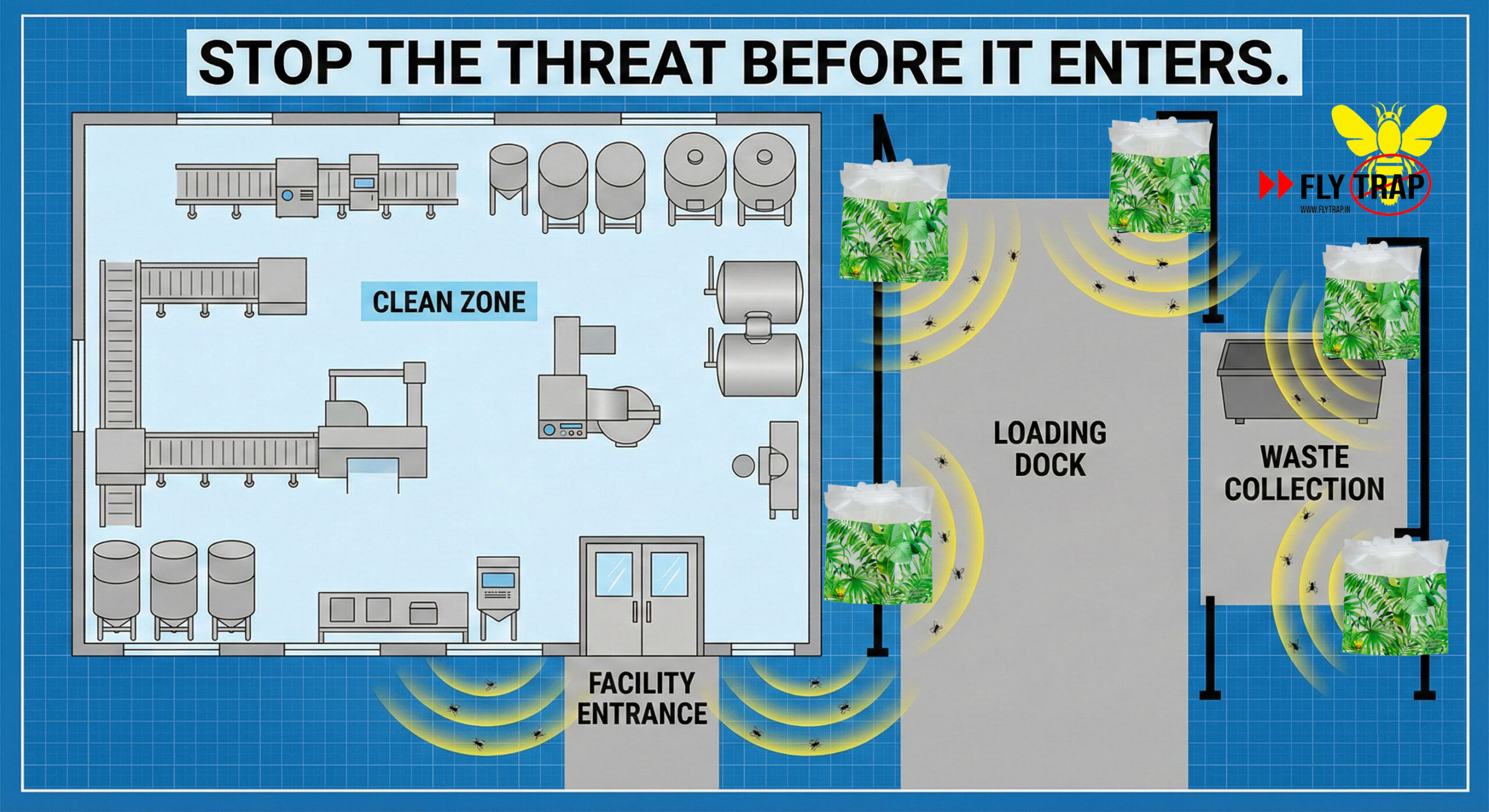
5 Critical Risk Zones in Your Facility
Raw Material Entry
Open docks and receiving bays. Highest fly ingress point. No visible barrier control in most Indian units.
Processing Floor
Exposed protein, warmth and moisture — perfect fly breeding conditions 12 months a year.
Waste & Drainage
Decomposing organic matter. Fly breeding hotspot — population doubles every 7 days without control.
Packaging Zone
Open product before sealing. Contamination here bypasses all upstream controls completely.
Cold Storage Entry
Temperature differential creates condensation; persistent fly pressure at cold chain entry doors.
How Infestation Compounds — Tap Each Stage
Entry & Infiltration
Flies enter via loading bays, vents, drains and door gaps. In Indian conditions, a 5mm gap under a rolling shutter is enough for a full infestation. Flies are attracted by the smell of raw material from up to 800 metres away.
LOW response window — first 24 hrsPathogen Transfer on Landing
Each landing deposits bacteria from the fly’s body, legs and mouthparts. A single fly makes 300+ landings per hour on open surfaces. It takes milliseconds — there is no visual warning before contamination occurs.
CRITICAL — product contamination activeRapid Breeding Cycle
One female lays 500–900 eggs over her lifetime. Full lifecycle: 7–10 days in warm processing facilities. Drain slime, organic waste and floor moisture are the most common breeding sites inside Indian food units.
HIGH — 10x population growth possiblePopulation Surge & Chemical Resistance
Without intervention, fly populations double every 7 days. Chemical sprays work for 1–2 cycles before full resistance develops. At this stage, no spray can reduce the population — only trapping and exclusion can break the cycle.
EXTREME — conventional control failsThe Perimeter Defense Model
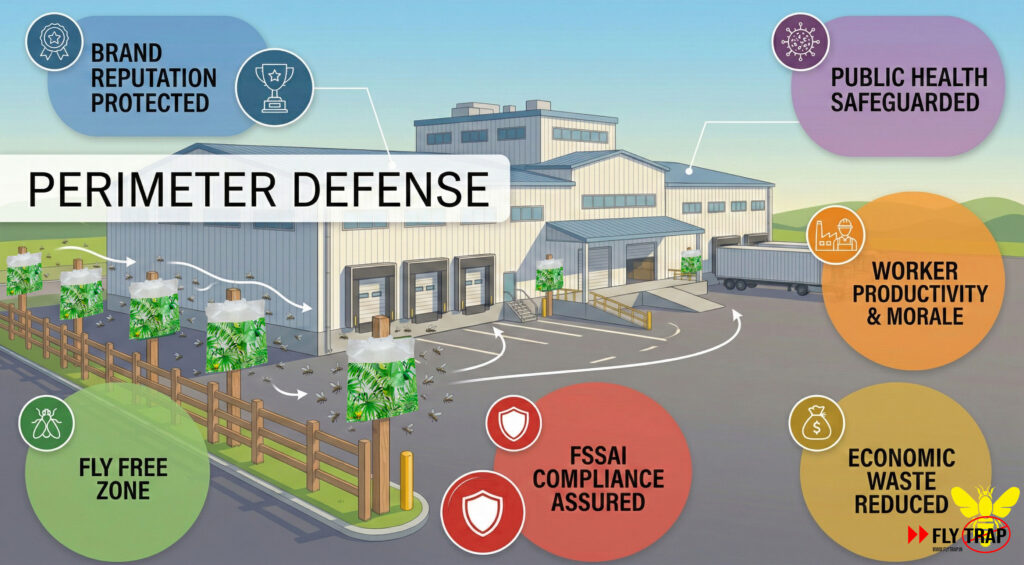
FlyTrap’s strategy moves the battle outside — intercepting flies before they reach your production floor.
India’s First Food-Grade Organic
Fly Trap for Processing Units
A non-toxic, non-pheromone, food-grade organic trap that intercepts flies at the perimeter before they enter your production floor. Zero chemicals, zero residue, FSSAI-aligned.
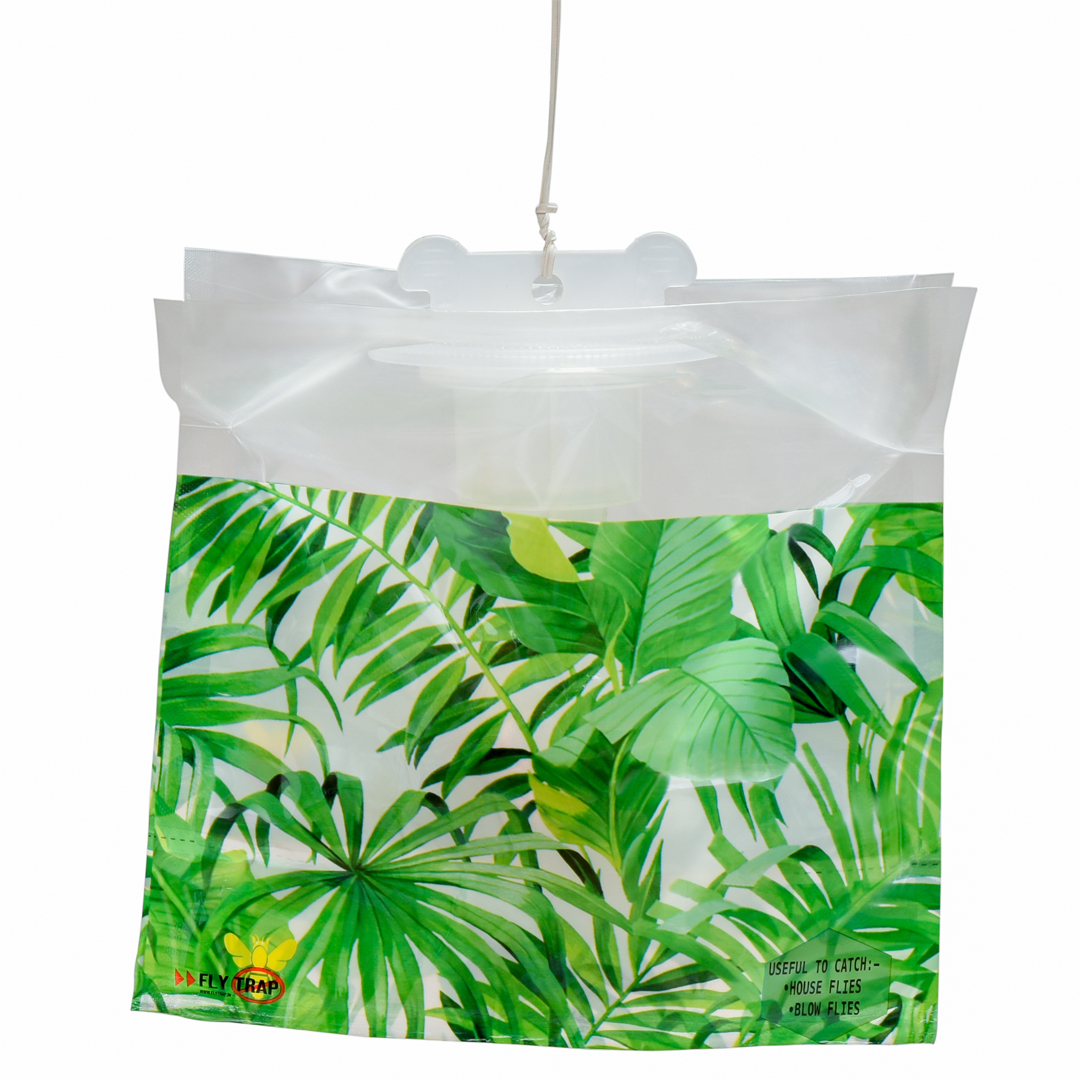
FlyTrap Organic Disposable Bag
Food-grade organic bait
Non-pheromone attractant. Catches both male and female flies. No residue on nearby product or surfaces.
30-day continuous protection
One trap per zone, active for 25–30 days. Replace at each production cycle start.
No resistance — ever
Organic food-based attractant. Unlike chemicals, flies cannot develop resistance. Works every season, indefinitely.
Zero production downtime
Hang and leave. No PPE. No evacuation. No waiting period before resuming production.
FSSAI Schedule 4 aligned
Organic physical control method. Fully documentable as a CCP under HACCP and ISO 22000 frameworks.
Setup in 4 Steps — No Training Required
Activate with Water
Fill to the marked line. Organic bait activates on contact — no chemicals, no measuring.
Position at Entry Points
Hang 3–4 ft high near docks, vents, drains and production entry doors. 10–20 ft outside is optimal.
Flies Enter, Can’t Escape
Both sexes drawn in and trapped. No mating = no breeding. Infestation cycle breaks in weeks.
Seal & Replace Monthly
Seal cap, dispose hygienically — zero fly contact. Replace before each new production batch.
Watch: Organic Fly Control
for Indian Food Facilities
How FlyTrap’s perimeter defense model works — and why Indian food processors are switching from chemical control.
FlyTrap vs. Conventional Methods
Switch between views to compare on compliance, safety, cost and effectiveness.
| Criterion | Chemical Spray | FlyTrap Organic |
|---|---|---|
| Product contamination | High risk | Zero |
| FSSAI compliance | Conditional / restricted zones | Fully compliant |
| Resistance buildup | After 2–3 applications | Never |
| Both sexes trapped | Kills adults only | Yes — breaks breeding |
| Production downtime | 4–8 hrs post-spray | Zero |
| Export audit risk | Chemical trace flag | No trace / no flag |
| Criterion | EFK / Zapper | FlyTrap Organic |
|---|---|---|
| Fly body fragmentation | Up to 7 ft spread | Zero fragmentation |
| Placement strategy | Attracts flies inside | Intercepts outside |
| FSSAI food-zone use | Restricted in open food areas | No restriction |
| Catches both sexes | No (kills by contact only) | Yes |
| Maintenance | Weekly cleaning required | Monthly swap |
| Product line risk | Exploded fly parts on product | None |
| Criterion | Thermal Fogging | FlyTrap Organic |
|---|---|---|
| Chemical residue | Surfaces + product | Zero |
| Worker safety | Full PPE + evacuation | No precautions |
| Downtime per session | 8–24 hrs | Zero |
| Export certification risk | Fogging records scrutinised | No chemical record |
| Frequency required | Every 2–4 weeks | Monthly passive trap |
| ESG / Sustainability | Not aligned | Biodegradable, organic |
Based on ICAR pest management studies and comparative efficacy data. Chemical spray figure reflects resistance buildup after 3 applications in the same facility.
Government Standards &
Certification Alignment
FlyTrap aligns with every major Indian food safety and export regulation. Here are the government bodies whose standards your facility must meet — and that FlyTrap supports.
FSSAI — Food Safety & Standards Authority
Schedule 4 pest management under FSS (Licensing) Regs 2011. Surprise audits increasing in 2026. Organic physical control strongly preferred in food contact zones.
fssai.gov.in ↗APEDA — Processed Food Export Authority
Zero pesticide residue mandatory for APEDA-registered export units. One failed test = shipment rejection. EU and USA buyers enforce this rigorously.
apeda.gov.in ↗Ministry of Food Processing Industries
Governs hygiene standards under PLI and PMKSY schemes. Pest management is a graded compliance criterion for PLI incentive disbursals.
mofpi.gov.in ↗Export Inspection Council of India
Certifies food processing plants for export. Chemical pest control in food contact areas can trigger rejection of EIC certification renewal audits.
eicindia.gov.in ↗National Horticulture Board — Cold Chain
Defines pest exclusion protocols for NHB-registered cold chain and processing facilities. IEC-compliant pest management required for subsidy disbursals.
nhb.gov.in ↗Certifications FlyTrap Helps Your Facility Maintain
FSSAI Central Licence
Schedule 4 pest management documentation — organic methods preferred
ISO 22000 / FSMS
Qualifies as documented physical hazard control in FSMS records
BRC / GFSI Audit
Zero-chemical pest control meets BRC Global Standard food zone requirements
HACCP CCP
Documentable Critical Control Point for biological hazard prevention
NPOP Organic Cert
No synthetic pesticide — maintains organic process chain integrity
The Real Cost of
Inaction vs. Organic Control
A single FSSAI inspection failure costs 50–100× more than a full year of FlyTrap deployment across your facility.
❌ Without Fly Control
✓ With FlyTrap Organic
Illustrative figures based on FSSAI penalty guidelines and industry-reported export rejection costs. FlyTrap cost estimate for 2 traps per 100 sq.ft at ₹200/trap, replaced monthly.
One Fly. One Audit. One Recall.
One Trap Can Prevent All Three.
India’s first organic food-grade fly trap for food processing facilities — FSSAI-aligned, export-safe, effective for 30 days. Zero chemicals. Zero downtime. Zero excuses.