
Across commercial broiler belts in India—from the intensive poultry clusters of Namakkal and Coimbatore to Hyderabad, Pune, and Northern broiler zones in Haryana and Punjab—the common house fly (Musca domestica) is often treated as an inevitable nuisance. However, research from the Indian Council of Agricultural Research (ICAR), the Indian Veterinary Research Institute (IVRI), and TANUVAS reveals that filth flies are an aggressive vector responsible for collapsing Feed Conversion Ratios (FCR), spreading devastating enteric pathogens, and triggering severe financial penalties from integrator companies and regional pollution control boards.
Historically, Indian poultry farmers relied on chemical premise sprays like Cypermethrin, Deltamethrin, and Dichlorvos (Nuvan). Today, that approach has hit a genetic dead end. Decades of unmonitored spraying have caused massive insecticide resistance, with Indian field strains tolerating chemical doses hundreds of times higher than baseline lethal limits.
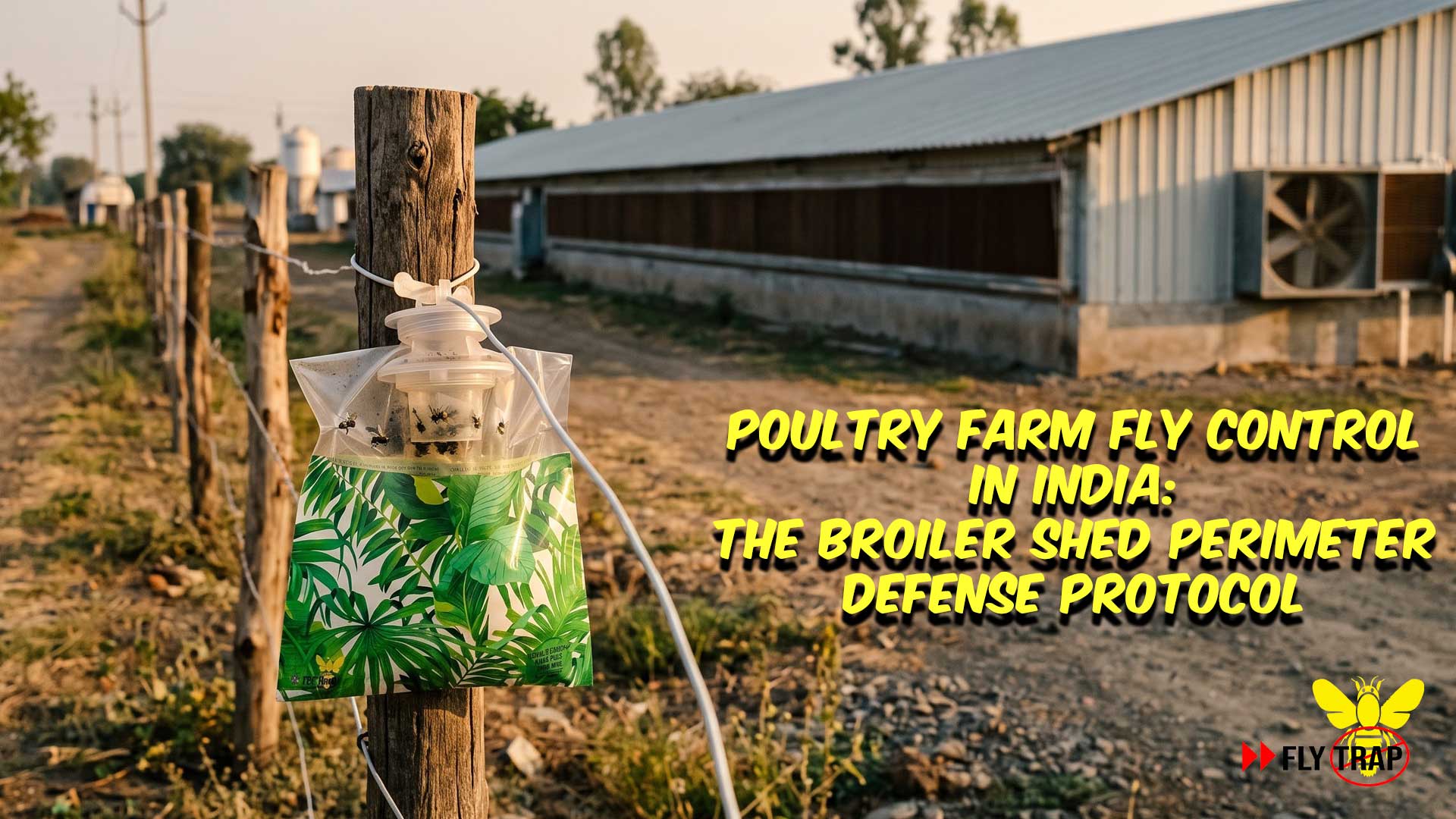
To protect bird performance, satisfy FSSAI pre-harvest hygiene norms, and avoid heavy losses under integrator contracts, progressive Indian poultry operators are adopting the 30-Foot Exterior Perimeter Trapping Protocol—a non-toxic, mechanical interception shield designed to eliminate adult breeding flies before they ever enter the shed.
1. The Pathogen Vector: ICAR & TANUVAS Epidemiological Reality
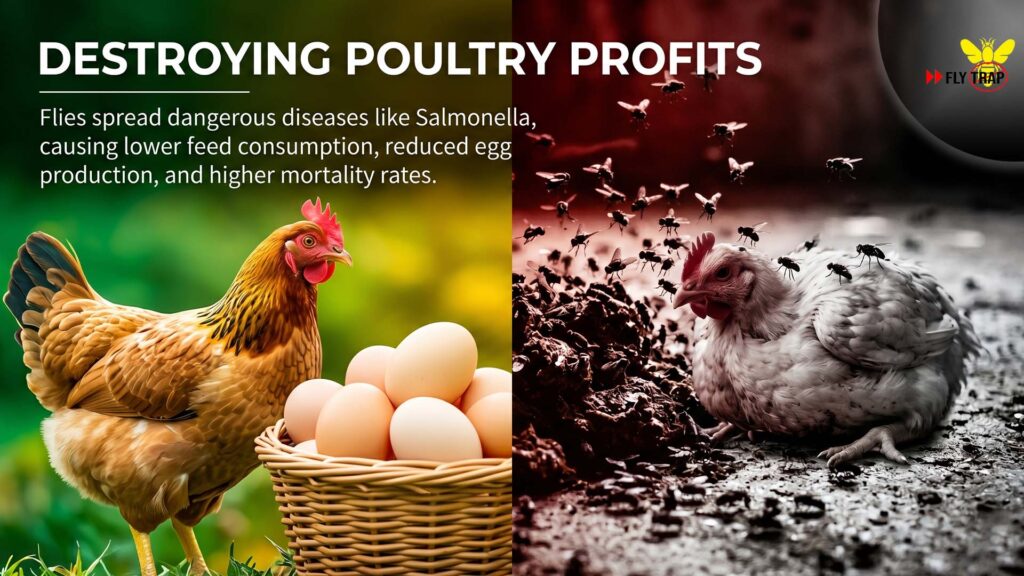
House flies do not merely hover over wet manure; their spongy mouthparts (labella) and sticky foot pads (pulvilli) act as physical carriers for over 100 pathogenic microorganisms. In the high-humidity, high-temperature conditions of Indian monsoons (June–September) and summer months, fly populations explode exponentially.
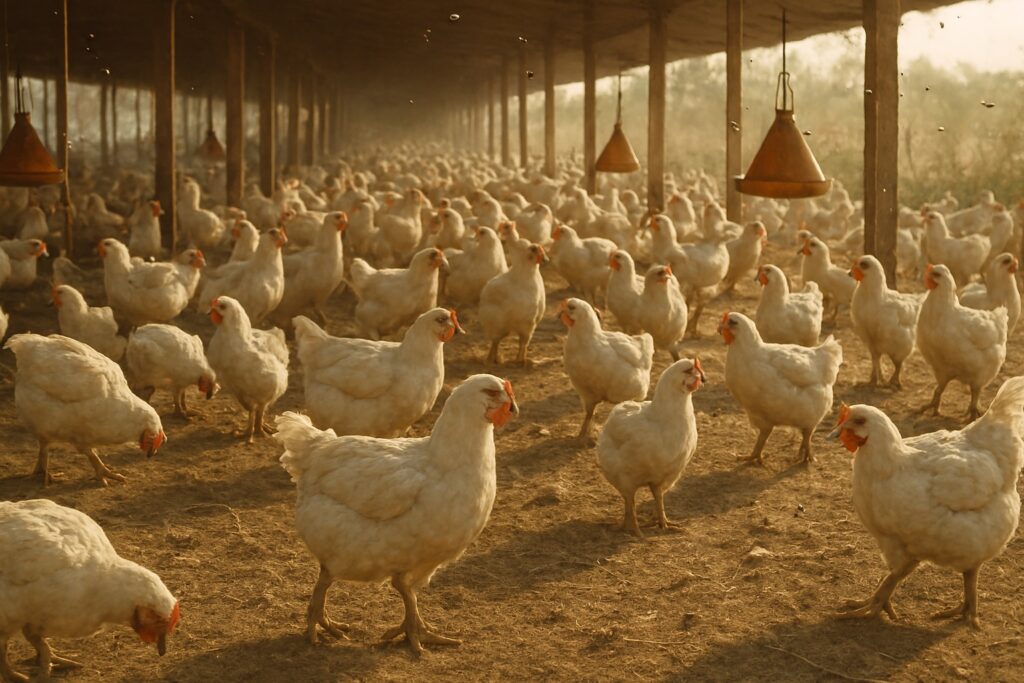
Studies conducted by the ICAR-Central Avian Research Institute (CARI) and Tamil Nadu Veterinary and Animal Sciences University (TANUVAS) confirm that filth flies are responsible for:
- Direct Flock Ingestion: In typical Indian deep litter and semi-EC sheds, broilers constantly peck at and ingest house flies resting on feed pans and drinker nipples. Ingesting just one pathogen-carrying fly introduces millions of colony-forming units (CFU) of Salmonella or Campylobacter straight into the bird’s gut.
- Colibacillosis & Coccidiosis Exacerbation: Flies mechanically carry pathogenic E. coli and transfer Clostridium perfringens spores across open feed lines, accelerating Necrotic Enteritis outbreaks between days 20 and 35 of the broiler cycle.
- FSSAI Pre-Harvest Non-Compliance: With modern Indian processing plants and QSR chains enforcing strict bacterial limits, high fly presence directly threatens farm-gate acceptance.
Credible Indian Scientific Source:
ICAR-CARI (Central Avian Research Institute) & IVRI (Indian Veterinary Research Institute), “Biosecurity and Vector Control Guidelines in Commercial Poultry Production”; TANUVAS Namakkal Poultry Extension Bulletins.
2. The Resistance Wall: Why Cypermethrin & Nuvan Are Failing in Indian Sheds
For decades, the default reaction to a fly swarm in Indian poultry farms was routine spraying with synthetic pyrethroids (Cypermethrin, Deltamethrin) or organophosphates like Dichlorvos (Nuvan). Today, field surveys across Andhra Pradesh, Telangana, Tamil Nadu, and Punjab show that pyrethroid resistance has rendered standard chemical sprays virtually ineffective.
The Genetic Driver Behind Spray Failures
Field studies confirm that Indian fly populations carry point mutations in the voltage-sensitive sodium channel gene (the kdr and super-kdr mutations). When farmers spray Cypermethrin, the chemical cannot bind to the nerve receptors. Surviving flies reproduce at 30°C–35°C in just 7 days, passing resistance genes to thousands of offspring.
Furthermore, chemicals like Dichlorvos (Nuvan) irritate chicken lungs, cause respiratory distress in heat-stressed birds, and risk regulatory action over chemical residues.
3. The 30-Foot Perimeter Protocol for Indian Poultry Sheds
Rather than spraying toxic chemicals inside the shed where birds breathe, modern biosecurity dictates establishing a 30-foot exterior interception perimeter (approx. 10 meters) around the shed walls using high-capacity organic traps.
The Golden Rule for Indian Farmers:
Never hang an organic attractant fly trap inside the poultry shed or directly against the side mesh. The attractant uses fermentation scent that flies can smell from 30 to 50 meters away. Hanging it inside invites outside flies into your flock. Always hang it outside, 30 to 40 feet away on fence lines or external bamboo/iron poles.
- The 30-Foot Distance (Approx. 10 Meters): Hang traps along the perimeter boundary or fencing, 30 to 40 feet away from the shed walls.
- Downwind from Exhaust Fans: In Environmentally Controlled (EC) sheds, hang traps 40 feet in front of the exhaust fan bank to catch flies drawn to the warm air plume.
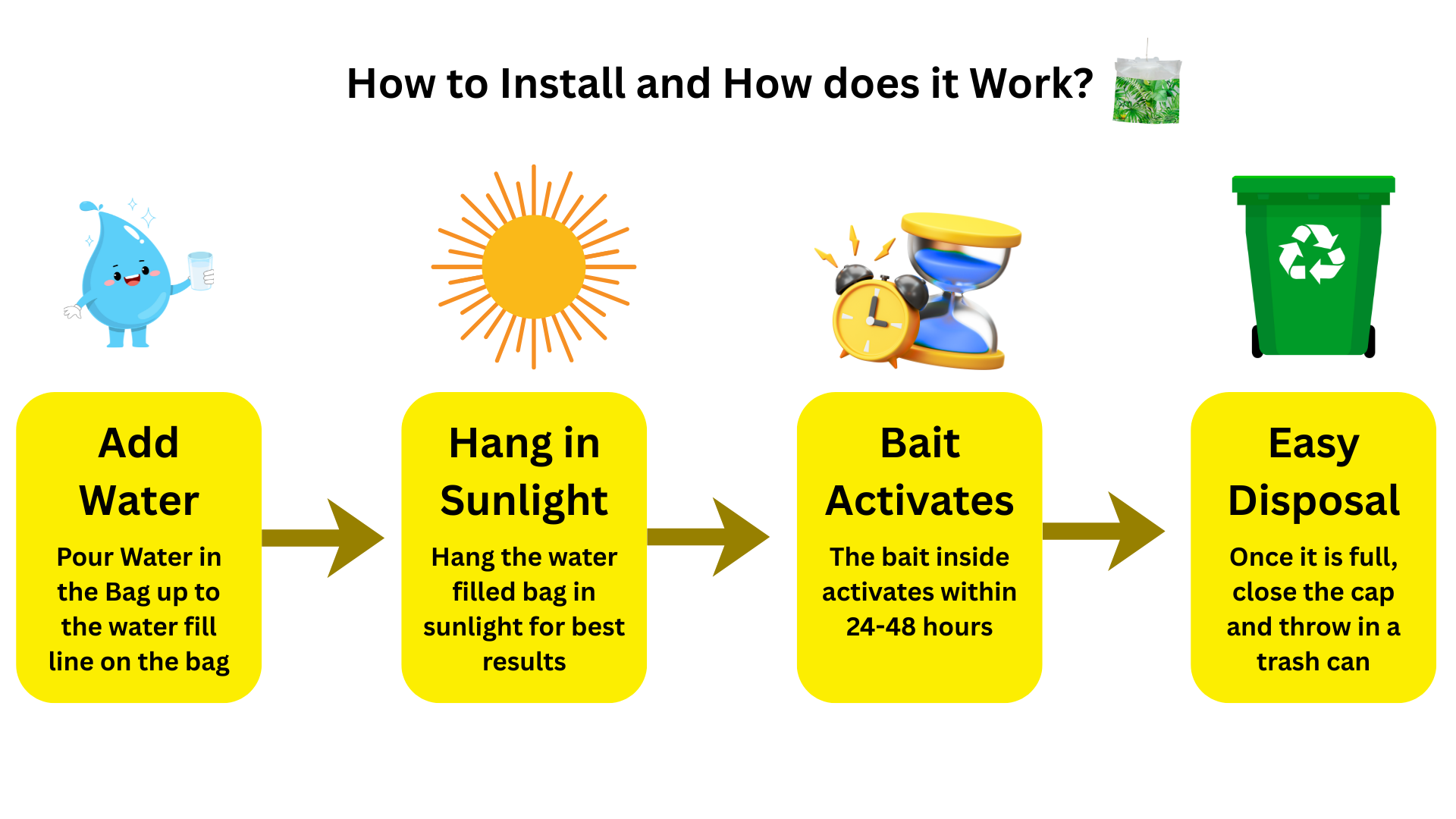
- Hanging Height: Suspend traps 4 to 5 feet off the ground (around chest height), directly in natural sunlight. Indian sunlight and ambient warmth (28°C–38°C) activate the organic lure within 24 to 48 hours.
- Water Replenishment: During hot Indian summers (April–June), check water levels weekly due to high evaporation. Simply add water through the top opening up to the marked fill line.
4. The Hidden Financial Drain: How Flies Burn FCR and Contractor Profits in India
In contract farming models (Suguna, Venky’s, IB Group, Skylark, Godrej Agrovet), grower payout is directly tied to the Feed Conversion Ratio (FCR). A rise of just 0.02 in FCR significantly eats into growing charges (GC).
The Real Cost of Fly Agitation on a 10,000-Bird Indian Broiler Batch:
- Flock Size: 10,000 broilers | Target Market Weight: 2.0 kg
- Total Live Weight: 20,000 kg
- FCR Degradation: Constant fly irritation, restless head-shaking, and poor resting cause a conservative 0.02 increase in FCR.
- Wasted Feed: 20,000 kg × 0.02 = 400 kg of additional commercial feed consumed.
- Feed Cost in India: At an average broiler feed price of ₹40 per kg:
400 kg × ₹40 = ₹16,000 Lost Profit Per Batch!
By eliminating fly swarms around the shed, you protect bird resting cycles and preserve up to ₹16,000 in feed efficiency per shed every 35–40 days.
5. Cost Comparison: Chemical Spraying vs. FlyTrap.in Organic Perimeter Traps
Compare the real operational costs for a standard 10,000 to 15,000 bird broiler shed over a 6-week cycle in India:
| Cost Component | Conventional Chemical Spray Routine | FlyTrap.in Perimeter Farm Protocol |
|---|---|---|
| Material / Product Cost | ₹2,000 – ₹2,800 (Cypermethrin, Nuvan, Malathion) | ₹2,599 (Set of 12 Farm Pack) |
| Labor Wages | ₹3,000 – ₹4,500 (6-8 spray rounds × ₹500/day labor) | ₹200 (One-time 30-minute hanging & water fill) |
| FCR & Stress Protection | Poor (Chemical fumes cause respiratory stress) | Saves up to ₹16,000 in feed efficiency |
| Total Out-of-Pocket Expense | ₹5,000 – ₹7,300 per batch | ₹2,799 total per batch |
| Direct Cash Savings: | Saves ₹2,200 to ₹4,500 in direct labor & chemical costs per shed every flock! | |
Frequently Asked Questions for Indian Poultry Farmers
Will the smell from the traps bother the chickens or neighboring villages?
No. By hanging traps 30 to 40 feet away from the shed along your farm boundary, the smell stays in the outdoor buffer zone. It will not enter through tunnel cooling pads or side curtains because air flows outward and upward.
How many traps are needed for a standard 10,000-bird Indian poultry shed?
A standard 400 to 500-foot commercial broiler shed needs 10 to 12 traps hung at 40-foot intervals around the perimeter. One Fly Trap Set of 12 (₹2,599) provides complete perimeter protection for an entire shed over a full batch.
Are these traps safe around farm dogs, cats, and birds?
Yes. The attractant is 100% pesticide-free, formulated with organic food-grade proteins and yeasts. There are no poisons or organophosphates. However, hang them 4 to 5 feet high so dogs cannot knock them over.
How should full fly bags be disposed of in India?
Each trap catches up to 20,000 flies. Once full or dried out after 45 days, simply push the top cap down to lock it shut. Place the sealed bag into your regular farm waste or deep bury it in farm compost. There is zero mess and zero contact with dead flies.
Upgrade Your Farm Fly Biosecurity Today
Protect your FCR, reduce chemical spraying expenses, and keep your sheds fly-free with India’s leading organic outdoor fly traps.
Free delivery across all major Indian states. Dispatched in 24–48 hours.